

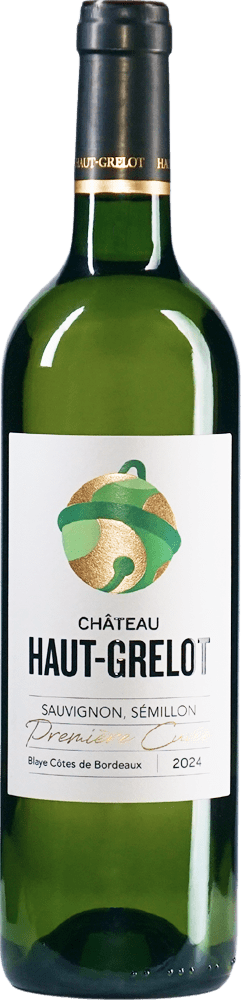
First Cuvée 2024
First Cuvée

Semillon
First Cuvée

Crisp green apple

In the glass, the wine appears clear and bright golden with a slight greenish shimmer – like freshly polished brass in the morning sun. Lean in appearance, with lively transparency and delicate 'church windows' that suggest: This is no sluggish drop, but a vibrant character.

The nose starts with crisp green apple, citrus zest, and a hint of grapefruit – as if someone had placed a fruit basket on fresh chalk. This is accompanied by a touch of damp stone, beeswax, and a very subtle floral undertone reminiscent of honeysuckle. Unobtrusively complex.

Grippy and clearly structured on the palate – almost chalky. The acidity brings so much tension that you almost feel like you could strike a match on it. The fruit remains precise: apple peel, lemon, a hint of passion fruit. The finish is delicately creamy and well-rounded.

Sauvignon Blanc meets Sémillon – both from clay and limestone plots around Blaye. Hand-picked, temperature-controlled fermentation in stainless steel tanks, followed by a short maturation on the fine lees. No oak bombast, but rather clean purism with substance. The wine thrives on the balance between freshness and depth.
Family Bordeaux with the river wind at its back since 1920.
Château Haut-Grelot did not start out as a grand estate, but as a small farm in the hamlet of Les Grelots (German: the bells - also visible on today's label). In the 1920s, Julien's great-grandfather and grandfather grew wine and raised cattle alongside it. In 1927, the crucial puzzle piece was added: their own well, which connected everything. In 1975, Joël Bonneau, Julien's father, took over, switched entirely to viticulture, and opened the door to direct sales in 1981. The idea behind it is simple: wine should regain a face and a conversation.
Today, Julien Bonneau and his sister Céline run the estate in the fourth generation. Approximately 67 hectares, of which about 25 hectares are white and 42 hectares are red. The grape variety palette ranges from Sauvignon Blanc, Sémillon, and Muscadelle to Merlot, Cabernet Sauvignon, Cabernet Franc, and Malbec. In the cellar, modern equipment meets a deliberately artisanal approach. Julien likes to speak of a balance between innovation and tradition. Technology is a means to an end, not the style.
Precise work is done in the vineyard: debudding, leaf removal, green harvesting, intentionally keeping yields low. This way, the grapes hang more loosely, get more sun and air, and ripen more calmly.
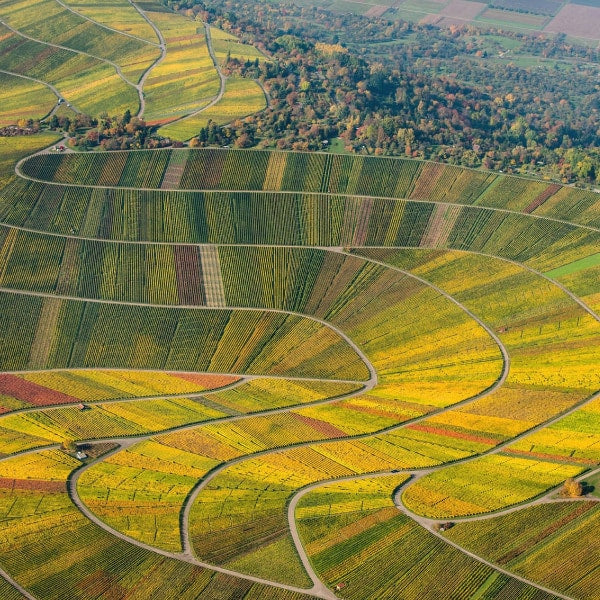
The terroir plays like a two-part harmony. Close to the Gironde estuary: sandy-gravelly slopes for juice and energy. Further inland: sandy-clay-loamy soils that add structure. The result: aromatic, fine white wines and fruity, powerful red wines with silky tannins. Bordeaux, but with more river wind at its back.


Other wines from the winery
-

Drink to see
2023
Château Haut-Grelot, Blaye Côtes de Bordeaux#intensiveFresh, tangy, and juicy.14,75 €19,67 € / L14,75 €19,67 € / L -

The Ace of Bells
2022
Château Haut-Grelot, Blaye Côtes de Bordeaux#intensiveDense, aromatic, and rustic.19,75 €26,33 € / L19,75 €26,33 € / L -

First Cuvée
2024
Château Haut-Grelot, Blaye Côtes de Bordeaux#sparklingCrisp, mineral, and finely structured9,50 €12,67 € / L9,50 €12,67 € / L -
The Ace of Bells
2023
Château Haut-Grelot, Blaye Côtes de Bordeaux#intensiveDense, aromatic, and rustic.19,75 €26,33 € / L19,75 €26,33 € / L -

Cuvée Selection Red
2022
Château Haut-Grelot, Blaye Côtes de Bordeaux#intensiveSucculent, polished, and candid.12,75 €17,00 € / L12,75 €17,00 € / L -

The CHATEAU HAUT-GRELOT Taster Pack
Château Haut-Grelot, Bordeaux#bestofbordeaux6x Premium wine from Bordeaux.Discover down-to-earth Bordeaux wines.69,00 €79,00 €15,33 € / L69,00 €79,00 €15,33 € / L


You might also like

First Cuvée
2024
Crisp green apple

In the glass, the wine appears clear and bright golden with a slight greenish shimmer – like freshly polished brass in the morning sun. Lean in appearance, with lively transparency and delicate 'church windows' that suggest: This is no sluggish drop, but a vibrant character.

The nose starts with crisp green apple, citrus zest, and a hint of grapefruit – as if someone had placed a fruit basket on fresh chalk. This is accompanied by a touch of damp stone, beeswax, and a very subtle floral undertone reminiscent of honeysuckle. Unobtrusively complex.

Grippy and clearly structured on the palate – almost chalky. The acidity brings so much tension that you almost feel like you could strike a match on it. The fruit remains precise: apple peel, lemon, a hint of passion fruit. The finish is delicately creamy and well-rounded.

Sauvignon Blanc meets Sémillon – both from clay and limestone plots around Blaye. Hand-picked, temperature-controlled fermentation in stainless steel tanks, followed by a short maturation on the fine lees. No oak bombast, but rather clean purism with substance. The wine thrives on the balance between freshness and depth.